
Exploring the History and Family of Refrigerants
2025-04-12
Refrigerant is a fluid medium circulating in the refrigeration system, the "blood" of the refrigeration system, and is also known as "refrigerant working medium", "refrigerant", "refrigerant gas", etc. It absorbs heat under low temperature and low pressure and discharges heat under higher temperature and pressure, usually involving a change in the physical state of the fluid. Theoretically, any substance that can undergo a phase change and generate heat conversion under certain conditions can be a refrigerant. However, considering factors such as economy, safety, and technical implementation, there are not many substances that are actually used as refrigerants. Especially in vapor compression refrigeration devices, due to working principles, device materials, etc., the number of substances that can be used as refrigerants is even smaller.
Let's first learn about the history of refrigerants:
In 1834, diethyl ether was the earliest refrigerant used;
In 1866, carbon dioxide was used as a refrigerant;
In 1870, ammonia was used as a refrigerant;
In 1874, sulfur dioxide was used as a refrigerant;
In the 1950s, azeotropic refrigerants began to be used;
In the 1960s, non-azeotropic refrigerants were used;
In the 1980s, work on the restriction and substitution of chlorofluorocarbons (CFCs) and hydrochlorofluorocarbons (HCFCs) began, and hydrofluorocarbons (HFCs) in Freon were gradually adopted.
In 1995, hydrocarbons began to be used in automotive air conditioners. Now, many refrigerators, freezers, and cold storage in Europe and the United States use hydrocarbons, such as propane (R290). China started the research, development, and production of isobutane refrigerators in 1993.
In recent years, due to its good thermal performance and environmental protection characteristics, carbon dioxide has regained attention and has been adopted as a refrigerant in refrigeration devices.
In 1834, diethyl ether was the earliest refrigerant used;
In 1866, carbon dioxide was used as a refrigerant;
In 1870, ammonia was used as a refrigerant;
In 1874, sulfur dioxide was used as a refrigerant;
In the 1950s, azeotropic refrigerants began to be used;
In the 1960s, non-azeotropic refrigerants were used;
In the 1980s, work on the restriction and substitution of chlorofluorocarbons (CFCs) and hydrochlorofluorocarbons (HCFCs) began, and hydrofluorocarbons (HFCs) in Freon were gradually adopted.
In 1995, hydrocarbons began to be used in automotive air conditioners. Now, many refrigerators, freezers, and cold storage in Europe and the United States use hydrocarbons, such as propane (R290). China started the research, development, and production of isobutane refrigerators in 1993.
In recent years, due to its good thermal performance and environmental protection characteristics, carbon dioxide has regained attention and has been adopted as a refrigerant in refrigeration devices.
There are many types of refrigerants. Currently, commonly used refrigerants include ammonia, various Freons, some hydrocarbons, and inorganic compounds. The classification of refrigerants in national standards is as follows:
- Freon refrigerants: Freon refrigerants are the general term for halogen derivatives of saturated hydrocarbons.
Freon refrigerants have stable chemical properties, low flammability, high inertness, and are basically non-toxic. When in contact with an open flame, they will decompose into highly toxic phosgene.
Chlorofluorocarbons (CFCs) are compounds formed after all hydrogen atoms in saturated hydrocarbons are completely replaced by chlorine and fluorine atoms, such as R11, R12, R22, etc., which are commonly used as refrigerants, fire extinguishing agents, and organic solvents. Since chlorofluorocarbons (CFCs) diffuse into the stratosphere, they will deplete the ozone layer and cause damage to living organisms on the earth from ultraviolet rays. According to the requirements of the international "Montreal" Protocol in 1987, the production and use of these refrigerants are gradually restricted and prohibited. - Azeotropic solution refrigerants: These refrigerants are composed of two or more refrigerants mixed in a certain proportion.
Their liquid and gas phases have the same composition in the equilibrium state (with a constant evaporation temperature under constant pressure). Binary mixed refrigerants, such as R500, which is composed of 73.8% R12 and 26.2% R152, and R503, which is composed of 40.1% R23 and 59.9% R13.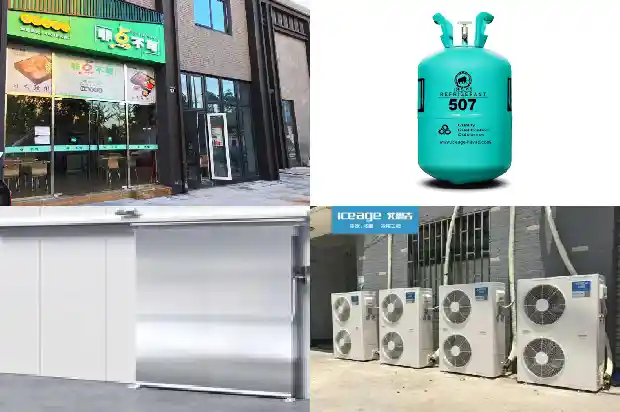
- Non-azeotropic refrigerants: A mixture of two or more refrigerants, in which the liquid and gas phases have different compositions in the equilibrium state. The composition of the low-boiling component in the gas phase is always higher than that in the liquid phase (the evaporation temperature varies with the composition under constant pressure).
- Inorganic compounds: There are ammonia (R717), water (R718), carbon dioxide (R744), air, etc. Ammonia has a large refrigeration capacity per unit volume and a low price, and is widely used in large land-based cold storage and industrial installations. Water is used as a refrigerant in steam jet refrigeration and lithium bromide absorption refrigeration.
- Hydrocarbons: Hydrocarbons used as refrigerants include ethane (R170), ethylene (R1150), propane (R290), propylene (R1270), etc., which are usually used in refrigeration devices in the petrochemical sector. Propane and propylene are used for two-stage compression refrigeration or for the high-temperature part of a cascade refrigeration system, and ethane and ethylene are used for the low-temperature part to obtain a low temperature below -80°C.
According to the international unified regulations, each refrigerant has a code starting with "R", that is, "R***" is used as the code for the refrigerant. "R" represents the refrigerant, combined with the following numbers and letters. Let's initially learn about the numbering of refrigerants:
- Numbering of halogenated hydrocarbons and hydrocarbons in the methane, ethane, propane, and cyclobutane series:
1.1 The first digit from right to left is the number of fluorine (F) atoms in the compound;
1.2 The second digit from right to left is the number of hydrogen (H) atoms in the compound plus one;
1.3 The third digit from right to left is the number of carbon (C) atoms in the compound minus one; if the number is zero, it is not written.
1.4 The fourth digit from right to left is the number of unsaturated carbons in the compound; if the number is zero, it is not written.
For example, propane, with the chemical formula C3H8, according to the above rules, its number is R290.
Isomers of the ethane series have the same number. Asymmetric isomers are distinguished by adding a, b, c, etc. at the end. For example, tetrafluoroethane, with the chemical formula C2H2F4, is numbered R134a. - Numbering of mixtures: Represented by the refrigerant number and the mass fraction of the composition, identified in the order of the standard boiling points of each component from low to high. For example, a mixture of 92% R502 and 8% R290 is numbered R290/22/115 (8/45/47).
The numbering of non-azeotropic refrigerants needs to indicate the mixture ratio. For example, the non-azeotropic refrigerant R400 (90/10) means it is composed of a mixture of R12 and R114 with a mass percentage of 90% and 10%.
Azeotropic refrigerants are assigned identification numbers in sequence in the 500 series and do not need to indicate the mixture ratio. For example, a refrigerant composed of 48.8% R22 and 51.
2% R115 is numbered R502.
- Other various organic compounds are numbered according to the 600 series.
- Inorganic compounds are numbered according to the 700 series, which is obtained by rounding the molecular weight of the compound and adding 700. For example, the molecular weight of ammonia is 17.03, so its number is R717; the molecular weight of water is 18.02, so its number is R718; the molecular weight of carbon dioxide is 44.01, so its number is R744. If the molecular weights of inorganic substances are the same, they are distinguished by A, B, C, etc.
Safety classification of refrigerants:
The safety classification symbol of refrigerants consists of a capital letter and a number, such as A1, B1, C1, etc.
The safety classification symbol of refrigerants consists of a capital letter and a number, such as A1, B1, C1, etc.
- Toxicity classification: The toxicity hazard classification of refrigerants has three categories: A, B, and C.
- Flammability classification: According to the degree of flammability hazard of refrigerants, it is divided into three categories: 1, 2, and 3.
In this way, there are 9 safety types of refrigerants:
When selecting and using refrigerants:
It should be noted that different refrigerants require different lubricating oils, and the sealing materials of the expansion valve, parameter settings, and selection of pressure vessels also need to be adjusted. For example, at the same temperature, R404 has a higher saturated pressure and a greater gas density than R22. Therefore, the sealing materials of the valves in the R404 refrigeration device, the design pressure of the pressure vessels, the setting values of the safety valves and fusible plugs, and the setting values of the high and low pressure switches are different from those of the R22 system. The R404 system uses ester-based lubricating oil, and the R22 system uses mineral lubricating oil.
It should be noted that different refrigerants require different lubricating oils, and the sealing materials of the expansion valve, parameter settings, and selection of pressure vessels also need to be adjusted. For example, at the same temperature, R404 has a higher saturated pressure and a greater gas density than R22. Therefore, the sealing materials of the valves in the R404 refrigeration device, the design pressure of the pressure vessels, the setting values of the safety valves and fusible plugs, and the setting values of the high and low pressure switches are different from those of the R22 system. The R404 system uses ester-based lubricating oil, and the R22 system uses mineral lubricating oil.
The charging amount of the refrigerant refers to:
a. The specified amount of refrigerant required for the normal operation of a closed refrigeration system.
b. The actual amount of refrigerant existing in a closed refrigeration system.
a. The specified amount of refrigerant required for the normal operation of a closed refrigeration system.
b. The actual amount of refrigerant existing in a closed refrigeration system.
If the refrigerant charging amount is too much or too little, or there is a refrigerant leak in the system, it will cause abnormal operation of the high and low pressure switches in the refrigeration device, abnormal noise of the expansion valve, abnormal suction or exhaust pressure, abnormal operation of the compressor, etc. Therefore, in the installation, commissioning, and daily maintenance of the refrigeration device, attention should be focused on the situation of the refrigerant.
Related Articles
- The Most Comprehensive Analysis of Water Pump Failures in History, Summarized by an Expert!
- Classification, Applications, Identification of Common Refrigerants and Impact of Purity on Refrigeration Systems
- 28 Kinds of Refrigerants: A Comprehensive Collection - All You Want to Know!
- Classification and Uses of Common Refrigerants
- Several Common Refrigerants
- Compare Various Refrigerants: Gain Quick Insights into Each Characteristic
- What Are the Commonly Used Refrigerants in Refrigerators and Cold Storages?
- Types of Refrigerants and Leak - detection Methods
- Four Combustible and Explosive Refrigerants: Precautions When in Use!
- Scheme for the Use and Safety of Ammonia Refrigerants
- Introduction to the Relationship between Refrigerants and Cold Storage Temperatures
- Four types of flammable and explosive refrigerants
- Performance of Eco-friendly Refrigerants 410A and R407C
- The characteristics and uses of 26 types of air conditioning refrigerants
- What Knowledge Points Should Users Know about the Safety Valve in the Refrigeration System?
- Can Cooling Towers Solve the Problem of Refrigeration Units Releasing Heat in Winter?
- Common Problems in the Installation and Maintenance of Cold Storage Systems
- Don't Worry When the Refrigeration Unit Malfunctions. Look Here!