
Manifestations of Insufficient Air - conditioner Refrigerant and Judgment of the Charging Amount
2025-03-14
I. Manifestations of Insufficient Refrigerant
① The gas pipe valve is dry, and there is no obvious cool feeling when touched by hand. The reason is that insufficient refrigerant causes the boiling end - point in the evaporator to advance, increasing the superheat of the refrigerant at this valve, raising the valve temperature, which becomes higher than the dew - point temperature of the outdoor air.
② The liquid pipe valve is frosted. The reason is that insufficient refrigerant leads to a drop in the pressure in the liquid pipe, reducing the boiling point and making the valve temperature lower than the freezing point.
③ Open the panel of the indoor unit and remove the filter, and it can be found that part of the evaporator is dewed or frosted.
④ The exhaust air from the outdoor unit has no hot feeling. The reason is that insufficient refrigerant causes the condensation pressure and condensation temperature to decrease, and the exhaust air temperature also drops.
⑤ The drainage hose drains intermittently or does not drain at all. The reason is that the refrigeration area of the evaporator decreases, the dewing area also decreases, and the amount of condensed water reduces.
⑥ There is oil stain on the gas and liquid valves of the outdoor unit. Where there is oil stain, there is leakage. The reason is that the refrigerant and refrigeration oil are somewhat mutually soluble. When fluorine escapes from the leakage point into the atmosphere, the oil adheres around the leakage point.
⑦ The measured operating current of the air - conditioner is less than the rated current. The reason is that insufficient refrigerant reduces the working load of the compressor, causing the current to drop.
⑧ The pressure measured at the fluorine - charging port of the outdoor unit is lower than 0.45 Mpa. The reason is that insufficient refrigerant leads to a decrease in the evaporation pressure.
② The liquid pipe valve is frosted. The reason is that insufficient refrigerant leads to a drop in the pressure in the liquid pipe, reducing the boiling point and making the valve temperature lower than the freezing point.
③ Open the panel of the indoor unit and remove the filter, and it can be found that part of the evaporator is dewed or frosted.

④ The exhaust air from the outdoor unit has no hot feeling. The reason is that insufficient refrigerant causes the condensation pressure and condensation temperature to decrease, and the exhaust air temperature also drops.
⑤ The drainage hose drains intermittently or does not drain at all. The reason is that the refrigeration area of the evaporator decreases, the dewing area also decreases, and the amount of condensed water reduces.
⑥ There is oil stain on the gas and liquid valves of the outdoor unit. Where there is oil stain, there is leakage. The reason is that the refrigerant and refrigeration oil are somewhat mutually soluble. When fluorine escapes from the leakage point into the atmosphere, the oil adheres around the leakage point.
⑦ The measured operating current of the air - conditioner is less than the rated current. The reason is that insufficient refrigerant reduces the working load of the compressor, causing the current to drop.
⑧ The pressure measured at the fluorine - charging port of the outdoor unit is lower than 0.45 Mpa. The reason is that insufficient refrigerant leads to a decrease in the evaporation pressure.
II. Accurate Judgment Methods for the Refrigerant Charging Amount
- Pressure Measurement
The temperature and pressure of the saturated vapor of the refrigerant have a corresponding relationship. If the evaporation temperature of the refrigerant is known, the corresponding evaporation pressure can be found. The gauge pressure value of this pressure is displayed by the high - and low - pressure gauges. Therefore, based on the pressure values shown on the gauges installed in the system, it can be judged whether the refrigerant charging amount is appropriate.
For example, if the evaporation temperature of the air - conditioner is 7.2℃, the condensation temperature is 54.5℃, and R22 is used. Check the corresponding table of the saturated temperature and saturated pressure of R22 to determine its evaporation pressure value and condensation pressure value. Looking up the table shows that for R22, at 7.2℃, the corresponding absolute pressure value is 0.53 Mpa (5.3 kg/cm²), and at 54.5℃, the corresponding absolute pressure value is 2.11 Mpa (21.1 kg/cm²). This pressure can be converted into a gauge pressure value.
Use high - and low - pressure gauges or a compound gauge to test the refrigeration system during fluorine charging. If the gauge pressure values of the high - and low - pressure gauges are within the above - mentioned range, it indicates that the refrigerant charging amount is appropriate. If both the high - and low - pressure values are low, it indicates that the charging amount is insufficient. If both the high - and low - pressure values are high, it indicates that the charging amount is excessive. The pressure - measurement method is relatively simple and is often used during maintenance, but its disadvantage is that it is rather rough and not highly accurate. - Weight Measurement
When charging Freon, prepare a small platform scale in advance. Place the refrigerant cylinder in a container, and then pour cold water below 40℃ into the container (suitable for low - pressure charging of refrigerant vapor in air - conditioners). Record the weights of the cylinder, warm water, and container before charging, and observe the pointer during the charging process. Stop charging when the reduction in the amount of refrigerant in the cylinder is equal to the required charging amount. - Operating Current Measurement
Use a clamp - on ammeter to measure the operating current. During refrigeration, when the ambient temperature is 35℃, the measured operating current corresponds to the current on the nameplate. The higher the temperature, the larger the current; the lower the temperature, the smaller the current. Compare the measured current value with the air - conditioner's operating conditions under normal fan operation and good heat dissipation of the two heat exchangers.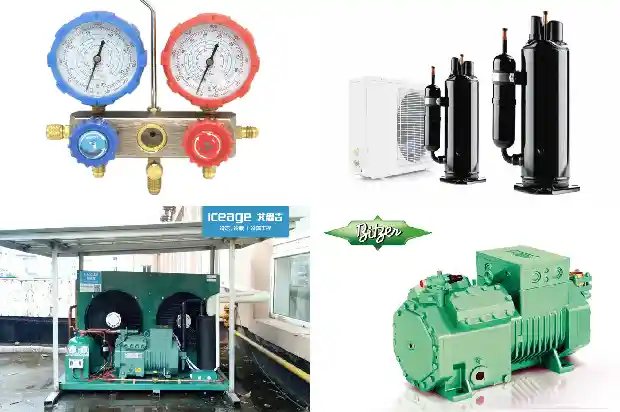
- Temperature Measurement
Use a semiconductor thermometer to measure the temperatures at points such as the inlet and outlet of the evaporator and the outlet of the accumulator to judge the refrigerant charging amount. The temperature difference between the inlet (150 mm in front of the capillary tube) and the outlet of the evaporator is about 7 - 8℃, and the temperature at the outlet of the accumulator should be 1 - 3℃ higher than that at the outlet of the evaporator. If the temperature difference between the inlet and outlet of the evaporator is large, it indicates insufficient refrigerant charging. If the frost - covered section of the suction pipe is too long or there is a frosting phenomenon near the compressor, it indicates excessive refrigerant charging.
Related Articles
- Why Does the Air Conditioner Evaporator Frost?
- Analysis of the Energy-saving Effect of Centrifugal Chiller Units in Air Conditioning Systems
- Practical: The Five Most Fundamental Problems in Air Conditioning Refrigeration
- You May Not Know All These Basic Knowledge of Refrigeration and Air Conditioning!
- Basic Knowledge of Refrigeration and Air Conditioning: You May Not Know It All!
- The 5 Most Fundamental Problems of Air Conditioning Refrigeration
- Knowledge of Air Conditioning Basics and Refrigeration Principles
- Principles for Setting Air Conditioning Air Outlets and Airflow Organization
- A Friend's Series of Discussions on Air Conditioner Leakage
- Common Knowledge of Refrigeration and Air Conditioning Systems!
- Four Major Components of an Air Conditioner: Principle, Structure, Adjustment and Faults of the Expansion Valve
- HVAC (Heating, Ventilation and Air Conditioning) — The Influence of Lubricating Oil on the Refrigeration System
- The air conditioner is leaking. While waiting for after-sales service, conduct a self-inspection first. Some problems can be handled by yourself
- Five Precautions for the Construction of Air Conditioning and Ventilation Systems
- Calculation Method of the Refrigeration Capacity of Precision Air Conditioners
- Air Conditioner - Horsepower vs Air Conditioner - Refrigeration Capacity
- Basic Tutorial on the Selection and Design of Water Pumps for Central Air Conditioning Water Systems
- Air Conditioning Design Schemes for Large Spaces like Theatres and Gymnasiums