
Refrigeration Components of Refrigeration
2025-02-25
The refrigerant vapor of the compressor enters through the suction port on the motor side, flows through the coils, crankcase, and the suction valve plate of the valve plate, and then enters the piston cylinder. It is then compressed in the piston cylinder. When the exhaust valve plate on the valve plate opens, the gas is discharged to the high - pressure side and flows to the oil separator or condenser. For a piston compressor that has been shut down for a long time, the crankcase heater should be operated for a certain period before startup.
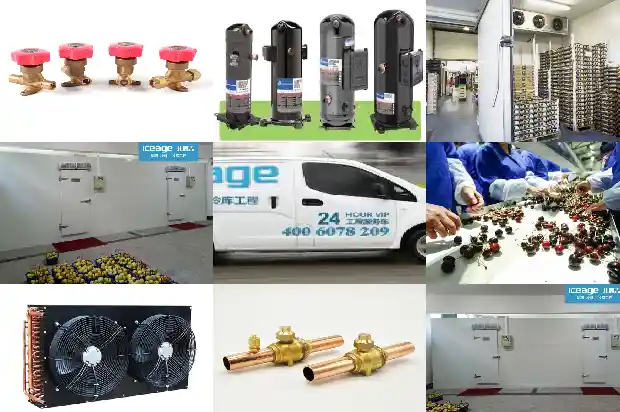
The shut - off valve is a manually - operated valve for cutting off or connecting the pipeline, generally used for larger pipelines.
The ball valve is a manually - operated valve for cutting off or connecting the pipeline, usually used for smaller copper pipelines.
The hand valve is a manually - operated valve for cutting off or connecting the pipeline, typically used for thinner copper pipelines like oil pipes.
Each unit is equipped with a set of pressure gauges, including a high - pressure gauge and a low - pressure gauge, which are used to monitor the system pressure and correct the sensor pressure.
The safety valve is generally installed on the top of pressure vessels (such as receivers, water - cooled condensers, evaporative condensers) (the opening pressure is generally 2.4 MPa for reference).
The liquid - supply and vapor - return filters can efficiently remove residual moisture, impurities, and acidic substances in the system. The filters equipped with the unit have replaceable filter elements.
Parallel units are all equipped with an oil filter, which can remove impurities in the oil circuit.
Each piston compressor is equipped with a protection device (e.g., INT69VS), which provides motor/exhaust over - heat protection and compressor start - stop frequency protection to ensure the compressor operates under safe working conditions.
Each piston compressor is equipped with an oil - pressure switch to prevent the compressor from running for a long time when the oil pressure difference is too low (in some cases, it means lack of oil). If the oil pressure difference is too low, the oil - pressure - difference switch will act and the compressor will stop.
The oil - level controller controls the opening and closing of the oil injection port according to the oil level in the compressor crankcase sensed by the oil - level sensing component, thereby adjusting the oil level of the compressor.
The thermostatic expansion valve regulates the refrigerant flow rate through the evaporator to maintain a pre - set temperature difference or superheat between the refrigerant in the evaporator and the refrigerant vapor at the evaporator outlet. When the temperature of the refrigerant gas leaving the evaporator changes, the temperature - sensing bulb of the expansion valve senses the temperature and adjusts the refrigerant flow rate through the expansion valve as needed.
The end - of - line filter is installed behind the end - of - line ball valve to prevent granular objects from flowing into the end - of - line solenoid valve and expansion valve along with the refrigerant, thus affecting the operation of these valves.
The shell - and - tube condenser has the advantages of a high heat - transfer coefficient and low cooling water consumption. An air - release cock is installed on the upper side of the condenser end cover to release air when filling with water, and a drain cock is installed at the bottom to drain all the water when the condenser is out of use in winter, so as to avoid cracking the heat - transfer tubes due to freezing.
Related Articles
- Basic Knowledge of Refrigeration Maintenance and Debugging
- Cold Insulation Construction in Refrigeration Equipment or Refrigeration Engineering
- Practical: The Five Most Fundamental Problems in Air Conditioning Refrigeration
- Precautions for the Installation of Automatic Instruments in Refrigeration Devices (Part Two)
- Why is the Evaporator Position Higher than the Compressor? Several Key Points of Oil Return in the Refrigeration System!
- You May Not Know All These Basic Knowledge of Refrigeration and Air Conditioning!
- Basic Knowledge of Refrigeration and Air Conditioning: You May Not Know It All!
- The 5 Most Fundamental Problems of Air Conditioning Refrigeration
- Six Common Refrigeration Methods
- What Impact Does Lubricating Oil Have on the Refrigeration System???
- Knowledge of Air Conditioning Basics and Refrigeration Principles
- The frosting directions of the refrigeration system are different, and the causes of frosting are completely different!
- Do You Master and Understand the Ten Key Temperatures of the Refrigeration System?
- Common Knowledge of Refrigeration and Air Conditioning Systems!
- These have the most direct relationship with the refrigeration effect
- HVAC (Heating, Ventilation and Air Conditioning) — The Influence of Lubricating Oil on the Refrigeration System
- Have You Encountered These Main Reasons for the Burning of Refrigeration Compressor Windings?
- Methods of Vacuuming, Leak Detection, Refrigerant Recovery and Charging for the Refrigeration System of a Cold Storage