
Interpretation of Components and Common Faults in the Cold Storage System
2025-05-06
Vapor Compression Refrigeration Cycle
The four main components of the refrigeration system: refrigeration compressor, condenser, throttling device (expansion valve, capillary tube, etc.), and evaporator. The four main components and the refrigerant are the necessary conditions for realizing the refrigeration cycle.
(1) Compressor: Commonly used types include piston type, screw type, scroll type, centrifugal type, rolling rotor type, etc.
(2) Condenser: Its main function is to cool and condense the superheated steam discharged by the compressor into a high-pressure liquid.
Water-cooled Condenser: The refrigerant vapor condenses outside the tubes in the shell, and cooling water flows inside the tubes. Generally, the cooling water enters from the bottom and exits from the top. It has a high heat transfer coefficient and good condensation effect, and is often equipped with a water pump and a cooling tower.
Air-cooled Condenser: Using air as the cooling medium, a fan is used to accelerate the air flow. It is suitable for places where water supply is difficult or it is not convenient to install equipment such as a cooling tower. The condensation effect is slightly worse.
(3) Throttling Device: Its main functions are to throttle and reduce the pressure, ensure the pressure difference between the condenser and the evaporator, so that the refrigerant evaporates and absorbs heat under low pressure (low temperature) in the evaporator; and adjust the refrigerant flow according to the change of the heat load of the evaporator.
Thermal Expansion Valve: Internal balance type, external balance type, capillary tube, electronic expansion valve.
(4) Evaporator: The liquid refrigerant after throttling vaporizes and absorbs heat (low temperature and low pressure) in the evaporator, reducing the temperature of the cooled medium.
Tube Bank: It has a simple structure and is easy to manufacture, but its heat transfer coefficient is low, and oil return is difficult.
Air Cooler: Generally, it is a non-full liquid type, with a small liquid filling amount, which is conducive to oil return, has less cold loss, and can reduce the temperature quickly.
Horizontal Shell and Tube Evaporator: Generally, it is a dry shell and tube evaporator, with a relatively high heat transfer coefficient, but oil return is more difficult. It is commonly used in chillers.
Auxiliary Equipment of the Cold Storage System
Auxiliary equipment: oil separator, gas-liquid separator, drier filter, solenoid valve, liquid receiver, oil collector, intercooler, evaporator pressure regulator.
(1) Oil Separator
Function: After separating the refrigeration oil in the refrigerant on the exhaust pipeline, the refrigeration oil directly enters the crankcase of the compressor, reducing the amount of oil carried into the refrigeration system and reducing the influence on the heat transfer effect of the heat exchanger.
Application: Refrigeration systems in medium and low temperature ranges and with long pipelines (liquid supply pipes and suction pipes).
(2) Gas-Liquid Separator
Function: Before the low-temperature and low-pressure refrigerant gas enters the suction valve of the compressor, it separates the unevaporated refrigerant liquid in the evaporator of the refrigeration system to prevent the compressor from experiencing a wet stroke (liquid hammer).
Application: Medium and low temperature working conditions.
(3) Drier Filter
Function: Absorbs the moisture in the liquid refrigerant and filters the dirt and impurities in the refrigerant. It is generally installed at the refrigerant outlet of the liquid receiver and the water-cooled condenser. There are usually several types for filtering moisture, filtering impurities, and filtering acid.
(4) Solenoid Valve
Function: When the compressor stops running, the solenoid valve closes to prevent the high-pressure refrigerant from entering the low-pressure system, and there will be no liquid hammer when the compressor starts again.
Installation Position: 100mm to 200mm away from the thermal expansion valve
(5) Liquid Receiver
Function: When the working conditions change or the refrigeration capacity is adjusted, it can balance and stabilize the refrigerant flow in the system, enabling the refrigeration device to operate normally. Its volume should be able to accommodate all the refrigerant, and the maximum accommodation capacity is 80% of its container volume.
(6) Oil Collector
Function: In a parallel system, it is often used to collect the oil separated by each oil separator, making each oil separator work normally, and then returning the oil to each compressor.
(7) Evaporator Pressure Regulator
The main function of the evaporator pressure regulator is to keep the internal pressure of the evaporator constant. Therefore, it will open and close according to the load condition of the evaporator. The pressure change at the outlet end of the regulator will not affect the opening degree because the pressure regulator is equipped with a balanced bellows (the areas of the bellows and the valve seat are equal). The evaporator pressure regulator has a pressure gauge interface for setting the required evaporator pressure.
(8) Intercooler
Function: It is mainly used in the low-temperature systems of two-stage or multi-stage compression refrigeration cycles to cool the superheated steam discharged by the low-pressure stage, ensure the intermediate pressure, and reduce the compression ratio.
System Installation and Design
The four main components of the refrigeration system: refrigeration compressor, condenser, throttling device (expansion valve, capillary tube, etc.), and evaporator. The four main components and the refrigerant are the necessary conditions for realizing the refrigeration cycle.
(1) Compressor: Commonly used types include piston type, screw type, scroll type, centrifugal type, rolling rotor type, etc.
(2) Condenser: Its main function is to cool and condense the superheated steam discharged by the compressor into a high-pressure liquid.
Water-cooled Condenser: The refrigerant vapor condenses outside the tubes in the shell, and cooling water flows inside the tubes. Generally, the cooling water enters from the bottom and exits from the top. It has a high heat transfer coefficient and good condensation effect, and is often equipped with a water pump and a cooling tower.
Air-cooled Condenser: Using air as the cooling medium, a fan is used to accelerate the air flow. It is suitable for places where water supply is difficult or it is not convenient to install equipment such as a cooling tower. The condensation effect is slightly worse.
(3) Throttling Device: Its main functions are to throttle and reduce the pressure, ensure the pressure difference between the condenser and the evaporator, so that the refrigerant evaporates and absorbs heat under low pressure (low temperature) in the evaporator; and adjust the refrigerant flow according to the change of the heat load of the evaporator.
Thermal Expansion Valve: Internal balance type, external balance type, capillary tube, electronic expansion valve.
(4) Evaporator: The liquid refrigerant after throttling vaporizes and absorbs heat (low temperature and low pressure) in the evaporator, reducing the temperature of the cooled medium.
Tube Bank: It has a simple structure and is easy to manufacture, but its heat transfer coefficient is low, and oil return is difficult.
Air Cooler: Generally, it is a non-full liquid type, with a small liquid filling amount, which is conducive to oil return, has less cold loss, and can reduce the temperature quickly.
Horizontal Shell and Tube Evaporator: Generally, it is a dry shell and tube evaporator, with a relatively high heat transfer coefficient, but oil return is more difficult. It is commonly used in chillers.
Auxiliary Equipment of the Cold Storage System
Auxiliary equipment: oil separator, gas-liquid separator, drier filter, solenoid valve, liquid receiver, oil collector, intercooler, evaporator pressure regulator.
(1) Oil Separator
Function: After separating the refrigeration oil in the refrigerant on the exhaust pipeline, the refrigeration oil directly enters the crankcase of the compressor, reducing the amount of oil carried into the refrigeration system and reducing the influence on the heat transfer effect of the heat exchanger.
Application: Refrigeration systems in medium and low temperature ranges and with long pipelines (liquid supply pipes and suction pipes).
(2) Gas-Liquid Separator
Function: Before the low-temperature and low-pressure refrigerant gas enters the suction valve of the compressor, it separates the unevaporated refrigerant liquid in the evaporator of the refrigeration system to prevent the compressor from experiencing a wet stroke (liquid hammer).
Application: Medium and low temperature working conditions.
(3) Drier Filter
Function: Absorbs the moisture in the liquid refrigerant and filters the dirt and impurities in the refrigerant. It is generally installed at the refrigerant outlet of the liquid receiver and the water-cooled condenser. There are usually several types for filtering moisture, filtering impurities, and filtering acid.
(4) Solenoid Valve
Function: When the compressor stops running, the solenoid valve closes to prevent the high-pressure refrigerant from entering the low-pressure system, and there will be no liquid hammer when the compressor starts again.
Installation Position: 100mm to 200mm away from the thermal expansion valve
(5) Liquid Receiver
Function: When the working conditions change or the refrigeration capacity is adjusted, it can balance and stabilize the refrigerant flow in the system, enabling the refrigeration device to operate normally. Its volume should be able to accommodate all the refrigerant, and the maximum accommodation capacity is 80% of its container volume.
(6) Oil Collector
Function: In a parallel system, it is often used to collect the oil separated by each oil separator, making each oil separator work normally, and then returning the oil to each compressor.
(7) Evaporator Pressure Regulator
The main function of the evaporator pressure regulator is to keep the internal pressure of the evaporator constant. Therefore, it will open and close according to the load condition of the evaporator. The pressure change at the outlet end of the regulator will not affect the opening degree because the pressure regulator is equipped with a balanced bellows (the areas of the bellows and the valve seat are equal). The evaporator pressure regulator has a pressure gauge interface for setting the required evaporator pressure.
(8) Intercooler
Function: It is mainly used in the low-temperature systems of two-stage or multi-stage compression refrigeration cycles to cool the superheated steam discharged by the low-pressure stage, ensure the intermediate pressure, and reduce the compression ratio.
System Installation and Design
- When the evaporator is above the unit, the pressure loss caused by the height of the liquid refrigerant increases, and bubbles will be generated. Therefore, the height difference should preferably be within 8 meters.
When the evaporator is below the unit: In order to facilitate oil return, an oil return bend should be set every 6 meters on the suction pipe. The height difference should be within 20 meters.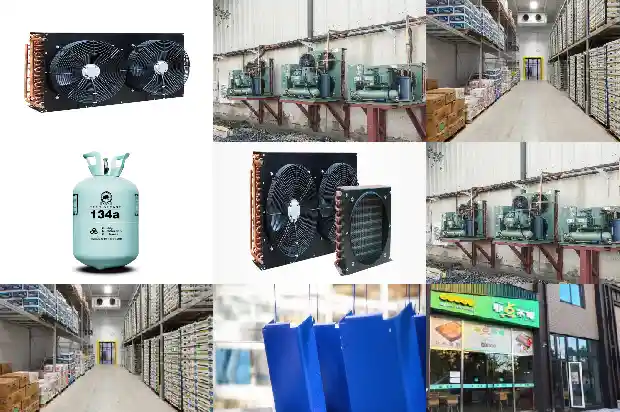
- If the diameter of the liquid supply pipe is too small, a large pressure drop will be formed, affecting the refrigeration effect. Generally, the liquid flow velocity in the liquid supply pipe is preferably 0.8 - 1 m/s. It can also be configured according to the liquid outlet pipe of the unit.
- When the evaporator is below the unit: In order to ensure oil return, the gas flow velocity in the vertical suction pipe must be greater than 7.6 m/s, and the gas flow velocity in the horizontal pipe must be greater than 3.8 m/s.
- The horizontal suction pipe should have a slope of not less than 2% towards the compressor, which is beneficial for oil return. When the evaporator is higher than the compressor, the return pipe of the evaporator should first bend upward to its highest point and then go downward to the compressor to prevent the liquid refrigerant from flowing into the compressor when the machine stops.
- For parallel units, an oil-gas balance pipe should be installed on the crankcase or a crankcase oil level controller should be installed. In order to prevent oil from flowing into the suction port of the compressor that is not in operation, the suction pipe of the compressor should be connected from the upper part of the suction header. The manufacture of the suction header should consider the uniformity of oil return of each compressor.
- In a refrigeration system with energy regulation or large variable load, in order to ensure oil return under low load, the design of double rising vertical pipes can be considered. When the machine stops, in order to prevent oil or condensed refrigerant from flowing back into the compressor, the horizontal exhaust pipe should have a slope of 1% towards the oil separator or the condenser.
- If the compressor is below the condenser (more than 3 meters), in order to prevent the liquid refrigerant from entering the compressor exhaust chamber after it condenses in the exhaust pipe when the refrigeration system stops running, a check valve should be installed near the exhaust valve of the compressor exhaust straight pipe or a U-shaped liquid collection bend to prevent backflow should be made, and then a liquid collection bend should be set every 6 - 8M.
- In order to ensure that the refrigerant liquid in the condenser flows smoothly into the liquid receiver, the pipe diameter should be selected according to the condition that the liquid flow velocity during full-load operation is not greater than 0.5M/S. Try to reduce the resistance loss of the pipeline during connection. The evaporator is generally connected in the way of liquid inlet from the top and outlet from the bottom to ensure smooth oil return.
- When conducting the pressure test, please use dry and clean nitrogen. Keep the suction and exhaust valves of the compressor closed, manually open the solenoid valve, slowly charge the system to 1.8MPA, apply soapy water at all joints and welded joints for leak detection, and maintain the pressure for 24 hours. If the pressure does not drop, it is qualified (excluding the influence of atmospheric temperature and pressure).
- Inspection of the protection device (inspection of the motor protection device).
Remove the power cable of the compressor and check the PTC thermistor in the motor. The PTC thermistor in the motor should be within the range of 200~600Ω. - Inspection of the protection device (inspection of the high-pressure controller).
Adjust the protection value of the high-pressure controller to be lower than the pressure of the system. At this time, the control circuit should be protected. Otherwise, the cause of the problem should be found out. - Inspection of the protection device (inspection of the low-pressure controller).
Adjust the protection value of the low-pressure controller to be higher than the pressure of the system. At this time, the control circuit should be protected.
Otherwise, the cause of the problem should be found out.
- Inspection of the protection device (inspection of the crankcase heater).
Inspection of the crankcase heater (the temperature in the crankcase is 20℃ higher than the ambient temperature) - Inspection of the protection device (inspection of the starting time of the split coil).
Disconnect the power cable of the compressor, start the control circuit, and check the suction time of the two contactors of the compressor. If it exceeds 1 second, adjust the time controller to make the suction time of the two contactors within 1 second. - Inspection of the protection device (other inspections).
Check other devices of the refrigeration system when the compressor is not running. For example: the operation of the air cooler of the evaporator, the fan of the condenser, the water pump of the water-cooled condenser, etc., whether the oil level is normal and whether the crankcase heater is working. - Check the high and low pressure conditions and the oil return status. The oil level in the crankcase should be within the range of 1/3~3/4.
If it is lower than 1/3 or the oil level cannot be seen, the oil return situation should be checked or refrigeration oil should be replenished.
- Check whether there are bubbles in the sight glass on the liquid supply pipeline. If there are bubbles, the refrigerant should be replenished until there are no bubbles in the sight glass.
- Check the temperature reduction situation of the refrigeration system, check whether the frosting and condensation situation of the pipeline after the expansion valve is normal, listen to whether there is the sound of liquid fluid flowing in the expansion valve, and adjust the corresponding evaporation temperature.
For the cooled medium being forced-circulated water or brine, the heat transfer temperature difference is generally taken as 5℃.
For the cooled medium being air with natural convection, the heat transfer temperature difference is generally taken as 10~15℃.
For the cooled medium being air with forced circulation, the heat transfer temperature difference is generally taken as 5~10℃. - Check the frost return situation of the compressor. In the medium and low temperature systems, the best position for the compressor to frost is at the suction valve. It is also acceptable if the frost is on the motor cover, but not on the cylinder head.
- Detect the operation current, voltage and other parameters of the compressor. Check that the oil pressure should be 0.15~0.35MPa higher than the suction pressure.
- Replace the refrigeration oil once after the newly manufactured and installed refrigeration system has been in operation for 100 hours. The next oil change depends on the cleanliness of the refrigeration oil or replace the refrigeration oil once every 10,000 to 12,000 hours of operation. Remember not to add too much oil.
- Replace the filter element of the drier filter once after the refrigeration system has been in operation for more than 1 year. If the system is very clean, the filter element or the filter may not need to be replaced.
Related Articles
- Four Major Components of an Air Conditioner: Principle, Structure, Adjustment and Faults of the Expansion Valve
- Basic Knowledge of Valve - type Components in Refrigeration Systems (Technical Sharing)
- Relationship and Adjustment between the Four Main Components of a Refrigeration System and Refrigeration Capacity
- Do You Know All the 34 Components of the Air-cooled Multi-connected Unit?
- Installation Precautions for the Source Components of Automatic Instruments in Refrigeration Units
- Several Key Components on the Oil Circuit of the Refrigeration System
- HVAC - Common Auxiliary Components of the Refrigeration System
- Analysis of the Main Functions and Components of Refrigeration Air Conditioners
- Analysis of Common Auxiliary Components in the Refrigeration System One by One
- Advantages and Disadvantages of Air-cooled Multi-connected Units and Analysis of Their Components
- Do You Have a Thorough Grasp of All 34 Components and Functions of the Air-Cooled Multi-Split System?
- Analysis of Common Auxiliary Components in the Refrigeration System
- Refrigeration Components of Refrigeration
- Principles, Components and Heat Recovery of Modular Units
- Basic Knowledge of Valve - type Components in Refrigeration Systems (Technical Sharing)
- Analysis of 6 Components in Air - cooled Multi - split Systems
- Analysis of Advantages, Disadvantages and 34 Common Components of Multi - split Air Conditioners
- Are you familiar with the detection and maintenance methods of air conditioner components?