
Design, Model Selection, Installation, Electrical Control and Precautions of Small Cold Storage
2025-04-30
I.

- Combination Types of Small Cold Storages
1.1 Independent Type: Each cold storage uses a set of storage body independently, with thermal insulation structures designed for each of the six surfaces, separated from the external space. This structure is convenient for installation and also easy to relocate and reinstall.
1.2 Combined Type: Two or more cold storages share part of the adjacent storage bodies. Doors can be opened to connect the adjacent storage bodies or opened separately for independent use. This structure requires high precision during installation and relocation, but it can save the amount of thermal insulation materials for the storage body. - Design of the Passage between the Cold Storage Body and the Outside
2.1 Door Types: According to the on-site usage requirements and the limitations of the passage width, the doors of the cold storage include sliding doors, sliding-sash doors, electric doors, rolling shutters, swing doors, etc. Among them, the most commonly used one is the sliding door. The sliding-sash door is mainly used when the passage width is limited, the sliding door cannot be fully opened, and a relatively large passage is required. The door can be made larger, allowing large equipment and handling tools to pass in and out freely.
2.2 Threshold Problem: Since the cold storage needs to have a thermal insulation layer, generally, to protect the thermal insulation layer, it is made 3 - 5 centimeters higher than the ground. With the thickness of the thermal insulation layer, it forms a step with the finished ground outside. However, this structure is convenient for installation and relocation. Another type is to make the inside of the cold storage at the same height as the outside ground, and even use the same ground material on top of the thermal insulation layer. In this way, the cold storage cannot be relocated, but it is more convenient for people and handling tools to enter and exit the cold storage. - Design and Selection of the Storage Panels
3.1 Thermal Insulation Materials: Generally, environmentally friendly polyurethane foaming materials are used, and some also use polystyrene foaming materials.
3.2 Selection of Formed Substrate Panels: Currently, the commonly used outer protective materials for foaming and forming mainly include color steel plates, galvanized steel plates, and embossed aluminum plates. In occasions with higher requirements or for special purposes, stainless steel plates are used.
3.3 Selection of the Thickness of the Thermal Insulation Layer: Generally, for cold storage panels with a storage temperature above -22 degrees Celsius, a 100mm-thick thermal insulation layer is used. For cold storages with a temperature below -22 degrees Celsius, a 150mm-thick thermal insulation layer is required. For those below -30 degrees Celsius, a 200mm-thick thermal insulation layer is adopted. - Other Related Requirements for the Cold Storage Body
4.1 Design of the Balance Window: After the cold storage is put into actual use, there will be a temperature difference of about 30 - 50 degrees between the inside and outside of the cold storage. Due to the sealing of the storage body, as the temperature drops, the gas will cause the situation where the cold storage door cannot be opened from the outside or the inside, causing trouble and even potential personal safety accidents. Therefore, each set of cold storage should be designed with a balance window to facilitate the replenishment of an appropriate amount of air when the internal pressure is low, so as to balance the internal and external pressures.
4.2 Design of the Door Frame Anti-condensation: Due to the gap between the door and the door frame, when the temperature difference between the inside and outside reaches about 10 degrees, the moisture in the air will condense on the surface of the door frame and even flow to the ground. Heating wires should be installed around the door frame of the cold storage to ensure that there will be no condensation phenomenon even in humid weather.
4.3 Hygiene Design: In high-end hotels, the requirements for the hygiene and cleanliness inside the cold storage are involved. That is, when designing, the joints of the cold storage should be made into rounded corners with a radius of more than 30mm, and the places where three sides meet should be made into spherical concave corners with a radius of more than 30mm to facilitate hygiene cleaning and prevent the occurrence of hygiene dead corners. Currently, in the domestic market, there are mainly directly formed storage panels with rounded corners and edges, and there are also ways of supplementing and installing with corresponding profiles.
II. Design and Selection of the Refrigeration System - Calculation of the Heat Load
Inside the cold storage, the main sources of heat affecting the storage temperature are:
1.1 Heat Flow of the Storage Body Structure: Mainly due to the existence of the temperature difference between the inside and outside of the storage, heat will always be conducted from the place with a higher temperature to the cold storage with a lower temperature. The main parameters affecting the heat flow are the temperature difference, the surface area of the storage body, and the heat transfer coefficient of the thermal insulation material.
The temperature difference of a certain cold storage is basically determined, and the surface area is constant. Therefore, choosing a good thermal insulation material can reduce the heat flow of the storage body.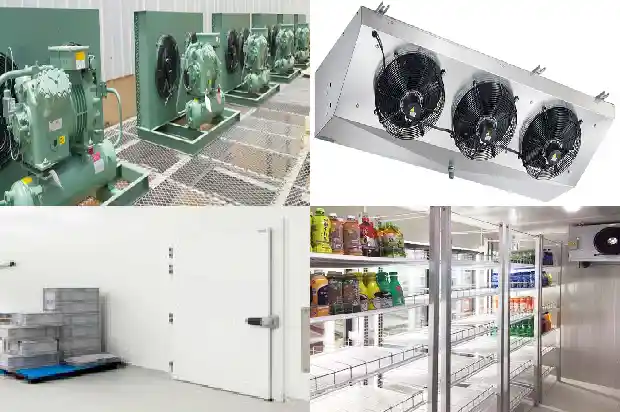
1.2 Heat Flow of the Goods: Although the main function of a small cold storage is to store refrigerated raw materials, semi-finished products or finished products that have been cooled, in practical applications, goods with a high temperature are often put into it for cooling. In addition, for fresh fruits and vegetables such as refrigerated vegetables and fruits, since their lives have not stopped, the heat generated by respiration is also part of the heat flow of the goods. Therefore, when designing the load of a small cold storage, the heat flow of a certain amount of goods should be considered. The daily storage volume is generally calculated according to 10% - 15% of the total capacity of the cold storage.
1.3 Heat Flow of Air Exchange: Fresh fruits and vegetables need to breathe and exchange air. A major feature of the use of a small cold storage is that the door is often opened, and air exchange inevitably occurs through the balance window. The external hot air enters the storage, generating a certain amount of heat flow.
1.4 Heat Flow of the Evaporative Fan and Others: Since the fan is required for forced convection to make the storage temperature quickly and evenly distributed, the heat and kinetic energy of the motor are completely converted into heat. The heat flow of the motor is generally calculated according to its running time, usually calculated based on 24 hours of work per day. In addition, there are the heat generated by the anti-freezing electric heating wire for the drain, the heat generated by the electric defrosting, and the heat generated by the anti-condensation electric heating wire, etc.
1.5 Heat Flow of the Operator: In a small cold storage, since people generally do not work there for a long time, it can generally be ignored.
The heat load is the direct basis for selecting the refrigeration compressor. Compared with large cold storages, the design requirements of small cold storages are not high, and the matching of the compressor is relatively simple. Therefore, generally, the heat load of a small cold storage does not need to be calculated through design, and the compressor can be matched according to empirical estimation.
Under normal circumstances, for a cold storage with an evaporation temperature of -10 degrees Celsius, calculated based on the daily storage volume of 15% of the storage capacity, the storage temperature of 20 degrees Celsius, it can be calculated at 120 - 150W per cubic meter of the internal volume of the cold storage; for a freezer with an evaporation temperature of -30 degrees Celsius, calculated based on the daily storage volume of 15% of the storage capacity, the storage temperature of 0 degrees Celsius, it can be calculated at 110 - 150W per cubic meter of the internal volume of the cold storage. During the estimation, as the volume of the cold storage increases, the cooling capacity per cubic meter gradually decreases. - Selection of the Refrigeration Compressor: Small cold storages generally use a fluorine system. Due to the frequent use of small cold storages, the failure rate is relatively high. Unless it is particularly necessary, each cold storage should be matched with a separate condensing compressor unit as much as possible to avoid the situation where several cold storages share a set of compressor units.
- Selection of the Air Cooler: Select an air cooler with a refrigeration capacity equivalent to the calculated or estimated refrigeration load. It should be noted that the calculation methods used by different air cooler manufacturers may be different, and the nominal refrigeration capacity and the actual refrigeration capacity should be corrected and calculated according to the evaporation temperature, temperature difference, and the type of refrigerant used. Unless necessary, generally each cold storage is equipped with only one air cooler. There are many air cooler manufacturers, and you can choose those produced by domestic or joint-venture factories according to actual needs.
III. Selection of the Electrical Control System of the Cold Storage
The refrigeration electrical control system is a necessary condition to ensure that the cold storage always works automatically within the set range. Its main working processes include:
A. After the compressor starts working: When the cold storage reaches the set temperature, the compressor stops working. When the storage temperature rises back to the set temperature, the compressor restarts and starts refrigerating;
B. Automatic Defrosting: Generally, the defrosting and heating action is automatically started every about 6 hours. There are two control parameters for defrosting, one is time and the other is temperature. When either of the two conditions is met, the defrosting process ends. After the end, a dripping time of about 2 minutes should be left before refrigerating again to make the temperature of the cold storage reach the required temperature as soon as possible;
C. Alarm Function: Issue a warning when the temperature of the cold storage exceeds the set requirement, so as to deal with it in a timely manner to ensure food safety.
D. Safety Requirements: The overall environment of the cold storage is relatively humid, and its surface is made of metal materials, which is prone to electric leakage. Therefore, it is better to use low-voltage equipment for the electrical appliances built into the cold storage, such as lighting lamps and anti-condensation electric heating wires.
IV.
Other Design Precautions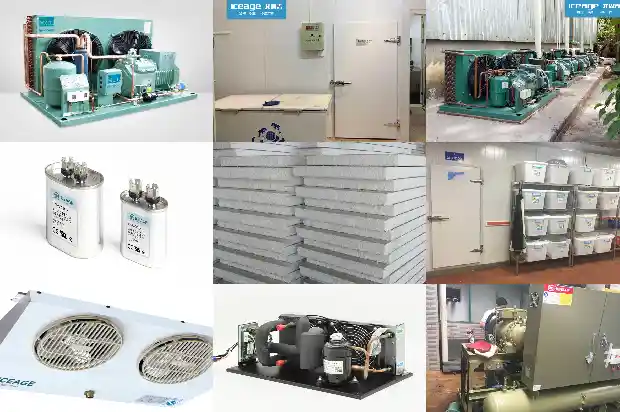
- Drainage: In the current design of small cold storages, air cooling is mainly used as the main method (more and more cold storages are also using water cooling now). The air cooler needs to be defrosted regularly to increase the heat exchange efficiency. Each cold storage should reserve an independent drainage position, generally a PVC drainage pipe with a diameter of 50 is sufficient, and the position is near the outside of the cold storage close to the air cooler.
- Exhaust: Since small cold storages are generally installed indoors and the matching of the compressor is relatively small, considering the refrigeration loss, the compressor is generally near the cold storage. Therefore, the heat discharged from the cold storage may be in a certain narrow space. At this time, exhaust should be considered to ensure that the condensation temperature of the compressor unit is appropriate. The exhaust volume should be no less than the exhaust volume of the condenser of the compressor unit.
- Moisture-proof: The outer formed substrate of the cold storage uses embossed aluminum plates, color steel plates or galvanized plates. Since the cold storage is at a low temperature for a long time and the surrounding area is relatively humid, moisture-proof measures should be taken, especially the thermal insulation material should not get wet, otherwise the thermal insulation effect will be greatly reduced.
Related Articles
- Five Questions to Answer Before Designing a System Using Natural Refrigerants
- Points to Note When Designing a Small Cold Storage
- Basic Tutorial on the Selection and Design of Water Pumps for Central Air Conditioning Water Systems
- Air Conditioning Design Schemes for Large Spaces like Theatres and Gymnasiums
- Selection Methods for Site, Capacity, Insulation Materials and Refrigeration System in Cold Storage Construction Design
- Cold Storage Design Parameters and Guide to Selecting Cooling Fans
- Summary of HVAC Design Parameters for Residential Buildings
- Precautions for the Design and Construction of Cleanrooms in Biopharmaceutical Industry
- A Brief Analysis of Quick - Freezing Cold Storage Design
- Why Should Refrigeration Shut - off Valves Have "Low - Inlet and High - Outlet" Design?
- Screw Compressor Units: Principles, Design and Selection - Essential Guide for Refrigeration Beginners
- Advanced Guide! Design and Installation of Refrigeration System Pipelines
- What Are the Acceptance Standards for Cold Storage Design and Installation?
- HVAC Design | Basics of Cooling Towers
- 【HVAC Design Summary】 - Free Cooling with Cooling Towers
- Fin Spacing Design of Cooler and Several Knowledge Points of Defrosting in Cold Storage
- Precautions for Cold Storage Design
- Classification, Principle, Model Selection and Application, and Troubleshooting of Fan Coils